Lesson 14: PACELC Theorem
Roadmap
You are in System Design Interview Prep, Track 01, Core Fundamentals: lesson 14 of 19 (CAP's missing half: latency vs consistency). It builds on Lesson 13: CAP Theorem. Next comes Lesson 15: Consistency Models.
These are the written notes for the lesson's video. Prefer paper? The same notes are a free, printable PDF: download SD-A-014.pdf.
Concept
PACELC says: during a Partition choose Availability or Consistency; Else, when healthy, choose Latency or Consistency, because keeping replicas in sync always costs waiting time.
Explanation
Reading the name
CAP only describes what happens during a network partition, and partitions are rare. PACELC (Daniel Abadi, 2010) covers the other 99%+ of the time. Read it as a sentence: if Partition, choose A or C; Else, choose Latency or Consistency.
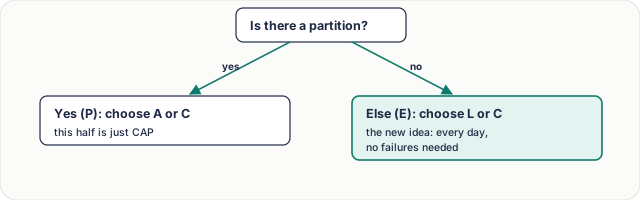
Figure 1. PACELC as a decision. The “else” branch applies every day, with no failures at all.
Why there's a trade-off without failures
Replication. To keep replicas consistent, a write must wait until other replicas confirm it, and waiting costs time. If you don't wait, you answer faster, but a replica may briefly return old data.
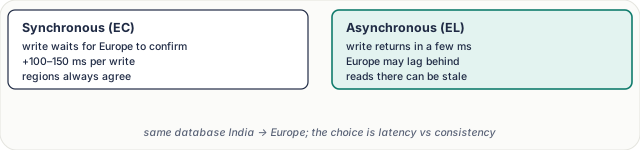
Figure 2. Synchronous replication pays latency for agreement; asynchronous pays staleness for speed.
Classifying real databases
| System | Class | What it means |
|---|---|---|
| Cassandra (default) | PA / EL | Available during partitions, fast otherwise; tunable per query |
| DynamoDB (default) | PA / EL | Eventually consistent reads by default; strongly consistent reads on request, at extra latency and cost |
| Google Spanner | PC / EC | Consistent always; pays with commit latency (TrueTime, cross-region consensus) |
| PostgreSQL + sync replica | PC / EC | Writes wait for the standby; no stale reads from it |
| PostgreSQL + async replicas | EL on reads | Fast writes; replica reads can lag |
A sharper interview answer. Don't stop at “it's AP”. Say what the system does during a partition and what it trades in normal operation: “We accept slightly stale reads for low latency on product pages, but reads on the checkout path go to the primary.”
Key terms
| Term | Meaning |
|---|---|
| PACELC | Partition: A or C; Else: L or C |
| Synchronous replication | write waits for replicas |
| Asynchronous replication | write returns, replicas catch up |
| Replication lag | how far a replica is behind |
| PA/EL | available + fast, may be stale |
| PC/EC | consistent always, slower |
Code
The "else" choice is not a property of the product; it is configuration you set. In PostgreSQL:
| Setting | What a COMMIT waits for |
PACELC |
|---|---|---|
| Asynchronous streaming replication (the default) | the primary's own WAL flush only; replicas catch up afterwards | EL: fast writes, replica reads may lag |
synchronous_standby_names = '*' with synchronous_commit = on |
the standby has the write on disk | durable on failover, but a read on the standby can still be a moment behind |
... with synchronous_commit = remote_apply |
the standby has applied the write | EC: no stale reads on that standby, slowest writes |
Other stores expose the same dial per request: Cassandra's consistency level, DynamoDB's ConsistentRead, and Redis's WAIT numreplicas timeout, which blocks until that many replicas have the earlier writes (Redis replication stays asynchronous, so a failover can still lose them).
How far behind a replica is, measured on the replica:
SELECT now() - pg_last_xact_replay_timestamp() AS replica_lag;
That number is your staleness budget: any read from this replica can be up to that far behind. (On an idle primary it keeps growing, because nothing new has been replayed; measure it under write load.)
Practice
1. Pay the E in PACELC
On a primary + streaming replica pair (the two-container setup in Backend Track 04, Module 08 is enough), benchmark writes with replication asynchronous, then synchronous:
docker compose exec primary pgbench -U postgres -i shop
docker compose exec primary pgbench -U postgres -c 4 -T 15 shop      # note "latency average"
docker compose exec primary psql -U postgres -c "ALTER SYSTEM SET synchronous_standby_names = '*'" -c "ALTER SYSTEM SET synchronous_commit = 'remote_apply'" -c "SELECT pg_reload_conf()"
docker compose exec primary pgbench -U postgres -c 4 -T 15 shop      # compare
What changed, and was there a partition?
Answer
Average latency goes up and transactions per second go down, because every commit now waits for a round trip to the standby and for the standby to apply it. On one machine the difference is small; across regions each write would pay roughly 100 ms more. There was no partition: this is the "else, latency or consistency" half of PACELC, paid on every write on a perfectly healthy day. Undo it with ALTER SYSTEM RESET synchronous_standby_names; ALTER SYSTEM RESET synchronous_commit; SELECT pg_reload_conf();.
Interview questions
Each question is tagged by kind: Basic (definitions), Scenario (apply it to a system) and Tricky (the follow-ups interviewers use to go deeper). Answer out loud before you open the answer.
What does PACELC add to CAP? (Basic)
What a strong answer covers
The else case: even with no partition, you trade latency for consistency, because replicas must coordinate to agree.
Classify DynamoDB under PACELC. (Basic)
What a strong answer covers
PA/EL by default (eventually consistent reads), with optional strongly consistent reads that move it toward consistency at extra latency and cost.
Why is Spanner PC/EC? (Basic)
What a strong answer covers
It keeps strong consistency always, using cross-region consensus and TrueTime, and pays for it with higher commit latency.
Your app replicates India → Europe. Users in Europe see old data after edits. Options? (Scenario)
What a strong answer covers
Make the replication synchronous for that data (EC, +100 ms writes), route the author's reads to the primary region for a while (read-your-writes), or accept the lag where it's harmless.
Which reads in an e-commerce site would you make strongly consistent? (Scenario)
What a strong answer covers
Inventory at checkout, payment status and order confirmation. Product pages, reviews and recommendations can be eventually consistent for speed and cost.
When would you pay for synchronous cross-region replication? (Scenario)
What a strong answer covers
When losing or disagreeing on a write is unacceptable (financial ledgers, critical config) and the business can accept ~100 ms more write latency.
Is a single-node PostgreSQL PA, PC, EL or EC? (Tricky)
What a strong answer covers
PACELC is about replicated systems. A single node is consistent but has no replicas to trade against; once you add async replicas, reads from them become EL.
Can one system be EL for one query and EC for another? (Tricky)
What a strong answer covers
Yes. Cassandra (consistency level per query) and DynamoDB (consistent-read flag) let you choose per request; describe the behaviour per feature.
Common mistakes & troubleshooting
- Thinking consistency only costs something during failures.
- Forgetting cross-region replication adds ~100 ms per synchronous write.
- Labelling a tunable database with one fixed class.
- Using strongly consistent reads everywhere “to be safe” and paying 2× cost.
- Assuming a synchronous standby never serves stale reads. With PostgreSQL's default
synchronous_commit = onit has the write on disk, not yet applied; onlyremote_applycloses that gap.
Further reading & sources
- Consistency Tradeoffs in Modern Distributed Database System Design (Daniel Abadi) - the paper that introduced PACELC and its "else, latency or consistency" clause.
- PACELC theorem (Wikipedia) - a short overview with a table classifying common databases.
- PostgreSQL: High Availability, Load Balancing, and Replication - streaming and synchronous replication, and what each
synchronous_commitlevel waits for.
Free PDF notes
Download these notes as a printable PDF, with every diagram: SD-A-014.pdf. All Phase 1 notes in one file: Phase 1, Core Fundamentals (PDF).
Next
Continue with Lesson 15: Consistency Models.