Lesson 13: CAP Theorem
Roadmap
You are in System Design Interview Prep, Track 01, Core Fundamentals: lesson 13 of 19 (what it really says, and what it doesn't). It builds on Lesson 12: Scalability. Next comes Lesson 14: PACELC Theorem.
These are the written notes for the lesson's video. Prefer paper? The same notes are a free, printable PDF: download SD-A-013.pdf.
Concept
When the network splits, a distributed system must choose between answering with possibly stale data (availability) and refusing to answer (consistency). Partitions are not optional, so “CA” is not a real choice.
Explanation
Precise definitions
“Consistency, availability, partition tolerance: pick two” is catchy, and misleading. The theorem (Brewer's conjecture, proved by Gilbert and Lynch in 2002) uses each word in a narrow sense:
| Property | Meaning in CAP | Not to be confused with |
|---|---|---|
| C · Consistency | Linearizability: every read returns the latest completed write, as if there were one copy of the data. | The C in ACID (database constraints) |
| A · Availability | Every request to a non-failed node gets a non-error response, without a time limit or a “try again”. | “99.99% uptime” (an SLO) |
| P · Partition tolerance | The system keeps operating when the network drops or delays messages between nodes. | Surviving a crashed server |
What happens during a partition
Take two replicas, A and B. The link between them breaks. Client 1 writes x = 2 to A, which cannot tell B. Client 2 then reads x from B, which still has the old value 1.
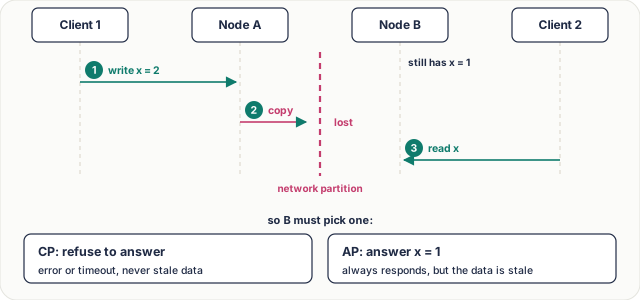
Figure 1. During a partition, node B cannot both stay consistent and keep answering. Whatever it does, it gives up one of the two.
That is the whole theorem: when a partition happens, you choose consistency or availability. You cannot opt out of partitions, because real networks lose packets, switches fail and cloud zones disconnect. So for any system spread over a network, “CA” describes either a single machine or a system that pretends the network never breaks.
What CAP does not say
- It says nothing about normal operation. With no partition, a system can be both consistent and available. CAP only describes the failure window.
- It is not a permanent label. The choice can differ per operation, per table or even per query. For each one, ask what is worse here: a stale answer or a refused request?
- It ignores latency. Even without failures, stronger consistency costs round trips between replicas. That everyday trade-off is what PACELC adds.

Figure 2. Partitions are short, rare windows. CAP describes behaviour inside them; PACELC adds the latency vs consistency choice for the rest of the time.
CP and AP systems in practice
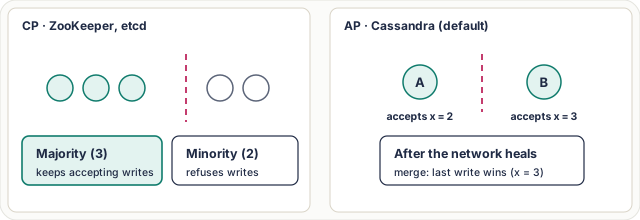
Figure 3. Left: a 5-node CP cluster split 3 / 2; only the majority side accepts writes. Right: an AP store accepts writes on both sides and merges them when the network heals (here, by keeping the later write).
| CP: choose consistency | AP: choose availability | |
|---|---|---|
| During a partition | The minority side rejects or times out requests | Every reachable node keeps reading and writing |
| How | Majority quorum (Raft, ZAB): a write commits only on more than half the nodes | Local writes, then repair: hinted handoff, read repair, last-write-wins or CRDTs |
| Examples | ZooKeeper, etcd, Consul; Spanner (CP with very high availability) | Cassandra and DynamoDB in their default modes, DNS, CDNs |
| Good for | Leader election, locks, configuration, bank balances, inventory counts | Shopping carts, social feeds, likes, metrics, sessions |
| Cost | Errors or waiting during failures | Stale reads and write conflicts to resolve |
Tunable consistency (Cassandra). With 3 replicas (N = 3), each query picks how many replicas must answer: ONE, QUORUM (2 of 3) or ALL. If the replicas written (W) plus the replicas read (R) is greater than N, every read overlaps the latest write: W + R > N, for example QUORUM writes and QUORUM reads (2 + 2 > 3). ONE / ONE is faster and more available, but can return stale data. So one database can behave CP-like for one query and AP-like for the next.
How to answer in an interview. Don't stop at a letter. Describe behaviour: “For the shopping cart I'd stay available during a partition and merge carts afterwards, because a lost sale costs more than a duplicate item. For payments I'd reject writes on the minority side, because a double charge is worse than a short error.”
Key terms
| Term | Meaning |
|---|---|
| Linearizability | reads see the latest write, as if one copy |
| Partition | nodes up but unable to talk |
| Quorum | a majority of replicas (more than half) |
| CP | refuse rather than be wrong |
| AP | answer rather than refuse |
| W + R > N | read and write sets overlap → consistent reads |
Practice
1. CP or AP?
For each system, decide how it should behave during a partition and give one sentence why:
- A bank's core ledger.
- An online store's shopping cart that must always accept "add to cart".
- An airline seat-reservation system that must never double-book a seat.
- A social app's like counter.
- The stock count for a flash sale that must never oversell.
Answer
- CP: a wrong balance is worse than a short error.
- AP: keep accepting adds on every side and merge the versions afterwards (the original Dynamo design).
- CP: selling one seat twice is real damage; refuse instead.
- AP: a count that is a few likes behind hurts nobody.
- CP: the count has to be authoritative, even if some requests wait or fail during the partition.
2. Merge a partitioned cart
A cart is replicated across two regions with asynchronous replication. During a partition the same user adds a book on their phone (served by region 1) and a lamp on their laptop (served by region 2). When the network heals, both adds must survive. What merge rule gives that, and why is last-write-wins wrong here?
Answer
Treat the cart as a set and merge concurrent adds by union, so the cart ends with both items. A CRDT such as an observed-remove set does this and also handles removes correctly. Last-write-wins keeps only the version with the later timestamp, so one device's add silently disappears, and the user notices. Choosing AP means you must also choose a conflict-resolution rule, and the right rule depends on what the data means: union for a cart, last-write-wins for "user's current profile photo", manual review for things like two edits to the same contract.
3. Diagnose: "writes stopped during a network blip"
A team runs PostgreSQL with one primary and one synchronous standby (synchronous_standby_names is set, so a COMMIT returns only after the standby confirms it). During a short partition between the two, every write hung and users got timeouts, although the primary itself was healthy. The team wants it to "never hang again, and never lose a write". What CAP choice does this setup encode, and what are their real options?
Answer
Synchronous replication is a deliberate CP choice: the primary will not confirm a write the standby does not have, so when it cannot reach the standby it waits instead of letting the two diverge. The hang is the guarantee working, not a bug. During a partition they can keep consistency or availability, not both:
- Stay CP and accept that writes pause while the standby is unreachable. Right when losing an acknowledged write is unacceptable.
- Lean AP: make the standby asynchronous. Writes keep flowing during a partition, but the standby can fall behind, and failing over to it can lose the last writes it never received.
"Never hang and never lose a write during a partition" is exactly what CAP rules out.
To see it yourself, use any primary + streaming replica pair (the two-container setup in Backend Track 04, Module 08 is enough). On the primary run ALTER SYSTEM SET synchronous_standby_names = '*'; SELECT pg_reload_conf();, then docker compose pause replica and try an UPDATE: it hangs. docker compose unpause replica and it returns. If you cancel the hung statement instead, PostgreSQL warns that the transaction "has already committed locally, but might not have been replicated to the standby": synchronous replication blocks the acknowledgement, it cannot undo the local write. Undo the setting with ALTER SYSTEM RESET synchronous_standby_names; SELECT pg_reload_conf();.
Interview questions
Each question is tagged by kind: Basic (definitions), Scenario (apply it to a system) and Tricky (the follow-ups interviewers use to go deeper). Answer out loud before you open the answer.
Explain the CAP theorem precisely. (Basic)
What a strong answer covers
During a network partition, a distributed system cannot provide both linearizable consistency and total availability: a node cut off from the latest write must either refuse the request or return possibly stale data.
Why is CA not a real option? (Basic)
What a strong answer covers
Partitions are not optional in a distributed system: networks fail. CA only describes a single node, or a system that assumes the network never breaks. The real choice is how to behave when a partition happens.
How is consistency in CAP different from the C in ACID? (Basic)
What a strong answer covers
CAP's C is linearizability: every read sees the latest write across replicas. ACID's C means a transaction keeps the database's rules (constraints, invariants) intact. A single-node database can be ACID-consistent with no replicas at all.
Which would you choose for a shopping cart, and for a payment ledger? (Scenario)
What a strong answer covers
Cart: AP. Keep accepting adds on both sides and merge afterwards; a duplicate item is cheap, a lost sale is not. Ledger: CP. Only the majority side commits; a short error is better than a double spend.
You're designing a distributed lock service. CP or AP? (Scenario)
What a strong answer covers
CP. Two clients holding the same lock is a correctness bug. Use a majority quorum (etcd, ZooKeeper) with leases, and give each lock a fencing token so a client whose lease expired can't keep writing. The minority side refuses lock requests during a partition.
A 5-node etcd cluster splits into 3 and 2. What happens on each side? (Scenario)
What a strong answer covers
The side with 3 has a majority: it keeps or elects a leader and keeps accepting writes. The side with 2 can't reach a quorum, so it rejects writes and linearizable reads. When the network heals, the 2 nodes catch up from the leader's log.
Is Cassandra AP or CP? (Tricky)
What a strong answer covers
AP by default, but tunable per query: with QUORUM reads and writes (W + R > N) it returns the latest acknowledged write, and those queries fail when a quorum can't be reached. Describe the behaviour, not just the letters.
With N = 3, W = 2 and R = 2, is every read guaranteed to be the latest? (Tricky)
What a strong answer covers
The read and write sets always overlap, so a read reaches at least one replica with the latest acknowledged write. But with last-write-wins timestamps, clock skew can make an older concurrent write win, and a failed partial write can show up later. It's strong in practice, not perfectly linearizable.
Common mistakes & troubleshooting
- “We'll pick CA”: impossible across a network.
- Treating CAP consistency as ACID consistency.
- Labelling a whole database CP or AP when its behaviour is tunable per query.
- Forgetting that CAP applies only during a partition.
- Choosing AP without a conflict-resolution rule. Two sides will diverge; decide how they merge (union, last-write-wins, CRDT, manual review) before it happens, or the default is silent data loss.
- Deciding partition behaviour during the incident. Pick it on purpose and rehearse it (practice 3) before production does it for you.
Further reading & sources
- CAP Twelve Years Later: How the "Rules" Have Changed (Eric Brewer) - the theorem's author on why "pick two" misleads and why the choice only bites during a partition.
- Please stop calling databases CP or AP (Martin Kleppmann) - why describing behaviour per operation beats a one-letter label.
- The CAP theorem (Julia Evans) - a short, plain explainer that takes apart the "pick two of three" myth.
- Dynamo: Amazon's Highly Available Key-value Store - the classic AP design: the always-writable cart, quorums (N, R, W) and merging divergent versions.
Free PDF notes
Download these notes as a printable PDF, with every diagram: SD-A-013.pdf. All Phase 1 notes in one file: Phase 1, Core Fundamentals (PDF).
Next
Continue with Lesson 14: PACELC Theorem.