# Lesson 17: Single Point of Failure
## Roadmap
You are in **System Design Interview Prep**, Track 01, **Core Fundamentals**: lesson 17 of 19 (find the weak link, then remove it). It builds on [Lesson 16: Fault Tolerance](../16-fault-tolerance/README.md). Next comes [Lesson 18: Simple Beats Clever](../18-simple-beats-clever/README.md).
These are the written notes for the lesson's video. Prefer paper? The same notes are a free, printable PDF: [download SD-A-017.pdf](https://backendroadmap.com/notes/system-design/SD-A-017.pdf).
## Concept
> [!key] A single point of failure is any component whose loss takes the whole system down; find them by walking the request path, remove them with active-passive or active-active redundancy.
## Explanation
### What a SPOF is
A chain of ten strong links breaks at its one weak link. A **SPOF** is any component that exists once and that everything depends on. Redundancy everywhere else doesn't help if one piece has no backup.
They hide in obvious places (a single database, load balancer or region) and in surprising ones: a single DNS provider, one TLS certificate about to expire, one deploy pipeline, one engineer who holds the keys.
### Finding them
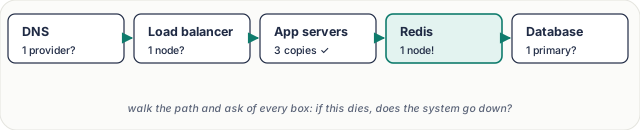
*Figure 1. The app tier is redundant, but sessions live on one Redis node. When it dies, every user is logged out at once.*
> [!example] **Fixing the Redis SPOF.** Add a replica in another zone with **Redis Sentinel** to detect failure and promote it automatically (usually within seconds), or run **Redis Cluster** with replicas per shard. Clients must reconnect to the new primary, so use a Sentinel-aware client.
### Two redundancy patterns
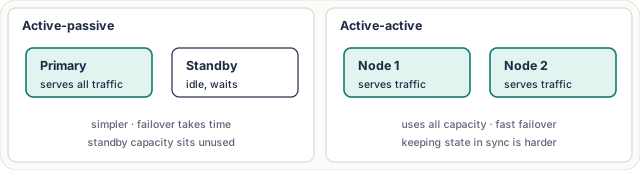
*Figure 2. Active-passive is simpler; active-active uses capacity better but needs state kept in sync across nodes.*
| | Active-passive | Active-active |
|---|---|---|
| **Traffic** | One node at a time | All nodes at once |
| **Failover** | Seconds to minutes (detect + promote) | Near-instant: others keep serving |
| **Cost** | Standby idle | All capacity used |
| **Hard part** | Promotion without split brain | Concurrent writes and conflicts |
| **Typical use** | Primary database + standby | Stateless app servers, multi-region reads |
### The database tier
- A primary with replicas in other zones, and **automatic failover** that promotes a replica when the primary dies.
- **Backups** stored elsewhere, with tested restores.
- At larger scale, multi-region, or a distributed database designed to survive losing nodes.
## Key terms
| Term | Meaning |
|---|---|
| **SPOF** | one component whose loss stops everything |
| **Active-passive** | standby takes over on failure |
| **Active-active** | all nodes serve at once |
| **Failover** | switching to a backup |
| **Redis Sentinel** | monitors Redis and promotes a replica |
| **Split brain** | two nodes both think they're primary |
## Interview questions
Each question is tagged by kind: **Basic** (definitions), **Scenario** (apply it to a system) and **Tricky** (the follow-ups interviewers use to go deeper). Answer out loud before you open the answer.
> [!interview] How do you find SPOFs? (Basic)
What a strong answer covers
Walk the request path (DNS, load balancer, app, cache, database) and ask of every component: if this dies, does the system go down? Include certificates, secrets, pipelines and people.
What a strong answer covers
Add replicas in other zones with automatic failover, plus tested backups; at scale, consider multi-region or a distributed database.
What a strong answer covers
Active-passive: one serves, a standby takes over (simpler, slower failover, idle capacity). Active-active: all serve (better use, faster failover, harder state sync).
What a strong answer covers
Sessions had one home. Add a replica with Sentinel for automatic failover, or Redis Cluster; or use signed session tokens so the cache isn't needed to stay logged in.
What a strong answer covers
It can be. Use a managed cloud load balancer (redundant by design) or a pair with a floating IP (VRRP/keepalived) and health checks, and spread across zones.
What a strong answer covers
If they're unavailable, nobody can ship or roll back. Automate the pipeline, document runbooks, and rotate on-call so several people can deploy.
What a strong answer covers
After a partition, two nodes both act as primary and accept conflicting writes. Prevent it with a majority quorum for promotion and fencing (the old primary is blocked from writing).
What a strong answer covers
Yes. A region-wide outage takes everything there down. Multi-region removes it, at the cost of replication latency, consistency trade-offs and higher spend; use it when the requirement justifies it.