 Availability Explained: The Nines, MTBF vs MTTR, Series vs Parallel
Lesson 10: Availability
Roadmap
You are in System Design Interview Prep, Track 01, Core Fundamentals: lesson 10 of 19 (the nines, MTBF vs MTTR, series vs parallel). It builds on Lesson 09: Throughput and Little's Law. Next comes Lesson 11: Reliability, Availability and Durability.
These are the written notes for the lesson's video. Prefer paper? The same notes are a free, printable PDF: download SD-A-010.pdf.
Concept
Availability is the share of time a system serves requests successfully; it depends on how often things fail and how fast you recover, and it multiplies down in series and up with redundancy.
Explanation
The nines
| Availability | Name | Downtime per year | Per month |
|---|---|---|---|
| 99% | two nines | ~3.65 days | ~7.3 h |
| 99.9% | three nines | ~8.76 h | ~43.8 min |
| 99.99% | four nines | ~52.6 min | ~4.4 min |
| 99.999% | five nines | ~5.3 min | ~26 s |
MTBF and MTTR
Two numbers drive availability: MTBF (mean time between failures: how often things break) and MTTR (mean time to recovery: how fast you fix them).
availability = MTBF / (MTBF + MTTR)

Figure 1. Recovering ten times faster gives ten times less downtime, with the same number of failures.
Series and parallel
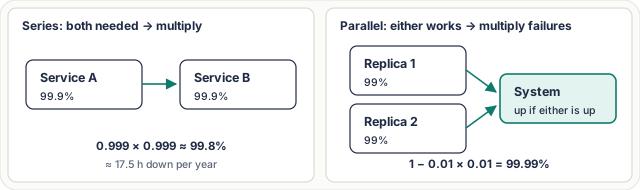
Figure 2. Dependencies in a chain multiply availability down; independent replicas multiply the failure chance down.
- Series (a request needs A and B): multiply the availabilities. Every extra dependency on the critical path lowers the total.
- Parallel (either replica can serve): multiply the failure chances. Two 99% replicas fail together only 0.01% of the time.
- The parallel maths holds only if failures are independent. Two replicas in the same rack, on the same power or with the same bad config fail together.
Worked example. A checkout calls the API (99.95%), the payment service (99.9%) and the database (99.95%) in series: 0.9995 × 0.999 × 0.9995 ≈ 99.8%, about 17.5 hours down a year. Run the database as a primary with a standby in another zone, each 99.95%: the pair is 1 − 0.0005² ≈ 99.99998%, and the chain improves to ≈ 99.85%. Now the payment service is the weakest link.
How to improve availability
- Redundancy across zones or regions, with failures as independent as you can make them.
- Remove single points of failure on the request path.
- Detect fast, fail over automatically: health checks and automatic promotion cut MTTR from an hour to seconds or minutes.
- Timeouts and careful retries, so a slow dependency doesn't hang everything.
- Shorten the critical path: make optional calls asynchronous or degrade gracefully when they fail.
Key terms
| Term | Meaning |
|---|---|
| Availability | share of time serving successfully |
| MTBF | mean time between failures |
| MTTR | mean time to recovery |
| Series | all parts needed: multiply availability |
| Parallel | any part enough: multiply failures |
| Critical path | calls a request can't succeed without |
Interview questions
Each question is tagged by kind: Basic (definitions), Scenario (apply it to a system) and Tricky (the follow-ups interviewers use to go deeper). Answer out loud before you open the answer.
Two services at 99.9% each, in series. What's the total? (Basic)
What a strong answer covers
About 99.8%, because you multiply: 0.999 × 0.999 ≈ 0.998, roughly 17.5 hours of downtime a year.
What do MTBF and MTTR mean, and how do they give availability? (Basic)
What a strong answer covers
MTBF is how long between failures; MTTR is how long to recover. Availability = MTBF / (MTBF + MTTR).
Two independent replicas at 99% each. What's the availability? (Basic)
What a strong answer covers
1 − (0.01 × 0.01) = 99.99%, because the system is down only when both fail at once.
You need 99.99% but each server gives 99.5%. What do you do? (Scenario)
What a strong answer covers
Run several replicas across zones behind a load balancer with fast health checks: two independent 99.5% replicas give 1 − 0.005² ≈ 99.9975%. Then check the rest of the chain (load balancer, database) also meets the target.
A service fails once a month and takes an hour to fix. Fastest way to improve it? (Scenario)
What a strong answer covers
Cut MTTR: automatic failover and good alerts can bring recovery to ~6 minutes, which takes availability from ~99.86% to ~99.986% without changing how often it fails.
Your page calls 8 services in series. How do you raise its availability? (Scenario)
What a strong answer covers
Remove non-essential calls from the critical path (make them async or optional with fallbacks), add redundancy to the weakest services, and use timeouts so a slow dependency degrades the page instead of failing it.
Why might two replicas give much less than the calculated 99.99%? (Tricky)
What a strong answer covers
Failures aren't independent: same zone, same power, same bad deploy or config, or a shared dependency like DNS. Correlated failures break the parallel maths.
Your dashboard shows 100% uptime but users report errors. How? (Tricky)
What a strong answer covers
The health check measures “process is up”, not “requests succeed”. Measure availability as the success rate of real requests (an SLI), not a ping.
Common mistakes & troubleshooting
- Adding dependencies without counting the multiplied availability.
- Assuming replicas fail independently when they share a zone or config.
- Focusing only on MTBF and ignoring recovery time.
- Measuring uptime from a health check while real requests fail.
Free PDF notes
Download these notes as a printable PDF, with every diagram: SD-A-010.pdf. All Phase 1 notes in one file: Phase 1, Core Fundamentals (PDF).
Next
Continue with Lesson 11: Reliability, Availability and Durability.