# Lesson 03: Functional Requirements
## Roadmap
You are in **System Design Interview Prep**, Track 01, **Core Fundamentals**: lesson 3 of 19 (what the system must do, and what to leave out). It builds on [Lesson 02: Client-Server and Multi-Tier Architecture](../02-client-server-and-multi-tier-architecture/README.md). Next comes [Lesson 04: Non-Functional Requirements](../04-non-functional-requirements/README.md).
These are the written notes for the lesson's video. Prefer paper? The same notes are a free, printable PDF: [download SD-A-003.pdf](https://backendroadmap.com/notes/system-design/SD-A-003.pdf).
## Concept
> [!key] Functional requirements are the features, written as user actions; pick the 3–5 that make the product work, park the rest, and confirm the list before you design.
## Explanation
### What they are
Functional requirements describe **what** the system does: its features. Not how fast or how big (that's non-functional, next lesson). Write them as **user actions**: “a user can create a short link”, “a user opening the link is redirected”. User actions are concrete, testable, and map straight to API endpoints.
### From questions to a short list
1. **Ask first.** Who are the users? What must they be able to do? What does success look like?
2. **List the core use cases.** For a URL shortener: create a short link, redirect to the original URL.
3. **Add the optional extras the interviewer cares about:** a custom alias, an expiry date.
4. **Park the nice-to-haves.** Write them down so the interviewer sees you thought of them, then leave them out.
5. **Confirm.** “I'll focus on creating and redirecting, with custom aliases and expiry. Analytics are out of scope. Does that match what you want?”
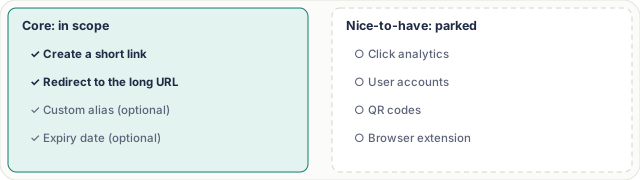
*Figure 1. A URL shortener's requirements, split into what you design now and what you park.*
> [!model] **The rule of thumb.** Keep **3–5 core use cases**. For each feature ask: without it, does the product still work? If yes, it's out of scope for now. A smaller scope lets you go deep on the hard parts in 45 minutes instead of drawing a shallow version of everything.
### Requirements decide the architecture
Every requirement adds work to the design, so the list you agree on shapes everything after it.
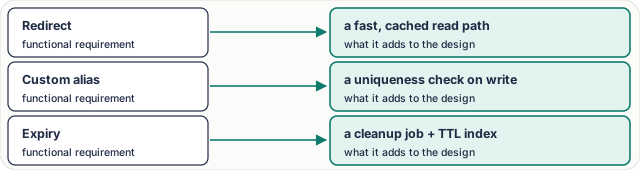
*Figure 2. Each functional requirement becomes a concrete piece of the design.*
### Worked example: a chat app
> [!example] **Chat app, in scope.** - Send and receive one-to-one messages
> - Group chats
> - Online status (presence)
> - Message history
> - Read receipts
> **Confirm the edges:** “Are media uploads, voice or video calls in scope?” Usually they are not, and each would add a large subsystem (object storage, media processing, real-time media servers).
## Key terms
| Term | Meaning |
|---|---|
| **Functional requirement** | a feature: what the system does |
| **Use case** | one user action and its result |
| **Scope** | what you will and won't design |
| **Nice-to-have** | noted, then parked |
| **Core use case** | without it, the product doesn't work |
| **Clarifying question** | turns a vague prompt into a list |
## Interview questions
Each question is tagged by kind: **Basic** (definitions), **Scenario** (apply it to a system) and **Tricky** (the follow-ups interviewers use to go deeper). Answer out loud before you open the answer.
> [!interview] How do you decide which features are in scope? (Basic)
What a strong answer covers
Ask clarifying questions, list the user actions, keep the 3–5 the product can't work without, park the rest out loud, and confirm the list with the interviewer.
What a strong answer covers
Functional says what the system does (“send a message”). Non-functional says how well (“delivered in under 500 ms, 99.99% available”). The first drives the API and data model; the second drives the architecture's capacity and redundancy.
What a strong answer covers
One-to-one messages, group chats, online presence, message history, read receipts. Confirm whether media, voice and video are in scope; usually they are not.
What a strong answer covers
Who uploads and who watches? Must I cover upload, processing, playback, search, comments, recommendations? Which are core? Then agree on something like upload, transcode, stream and view counts, and park the rest.
What a strong answer covers
Show you parked it on purpose, then sketch how it plugs in without redesigning: emit a click event on each redirect to a queue, aggregate it asynchronously, and keep the redirect path fast.
What a strong answer covers
A uniqueness check at write time (a unique index or conditional insert), a rule for reserved words, and a clear error when the alias is taken.
What a strong answer covers
Time and depth. In 45 minutes a broad design stays shallow; interviewers score depth on the hard parts. A tight scope also makes the capacity estimates and trade-offs concrete.
What a strong answer covers
No, it's a quality attribute (non-functional). A functional version would be a specific action, like “only the owner can delete their link”.